In a world-first, a superconductor magnet developed by Te Herenga Waka scientists has hitched a ride on a rocket into orbit—and home again.
It’s one small superconducting magnet that could result in one giant leap forward for space travel. A revolution in the way spacecraft are propelled may be within reach thanks to out-of-this-world technology that’s being developed by researchers at Te Herenga Waka—Victoria University of Wellington. But how do you know if your invention actually works in the challenging and unique environment of space?
The team behind the Hēki mission is finding out. Hēki is an in-space demonstration of a powerful superconducting magnet small enough to rest in one hand along with bespoke control electronics and a “flux pump” which energises the magnet. Its developers at the University’s Paihau—Robinson Research Institute think the small unit could hold the key to dramatically improving propulsion efficiency in space.
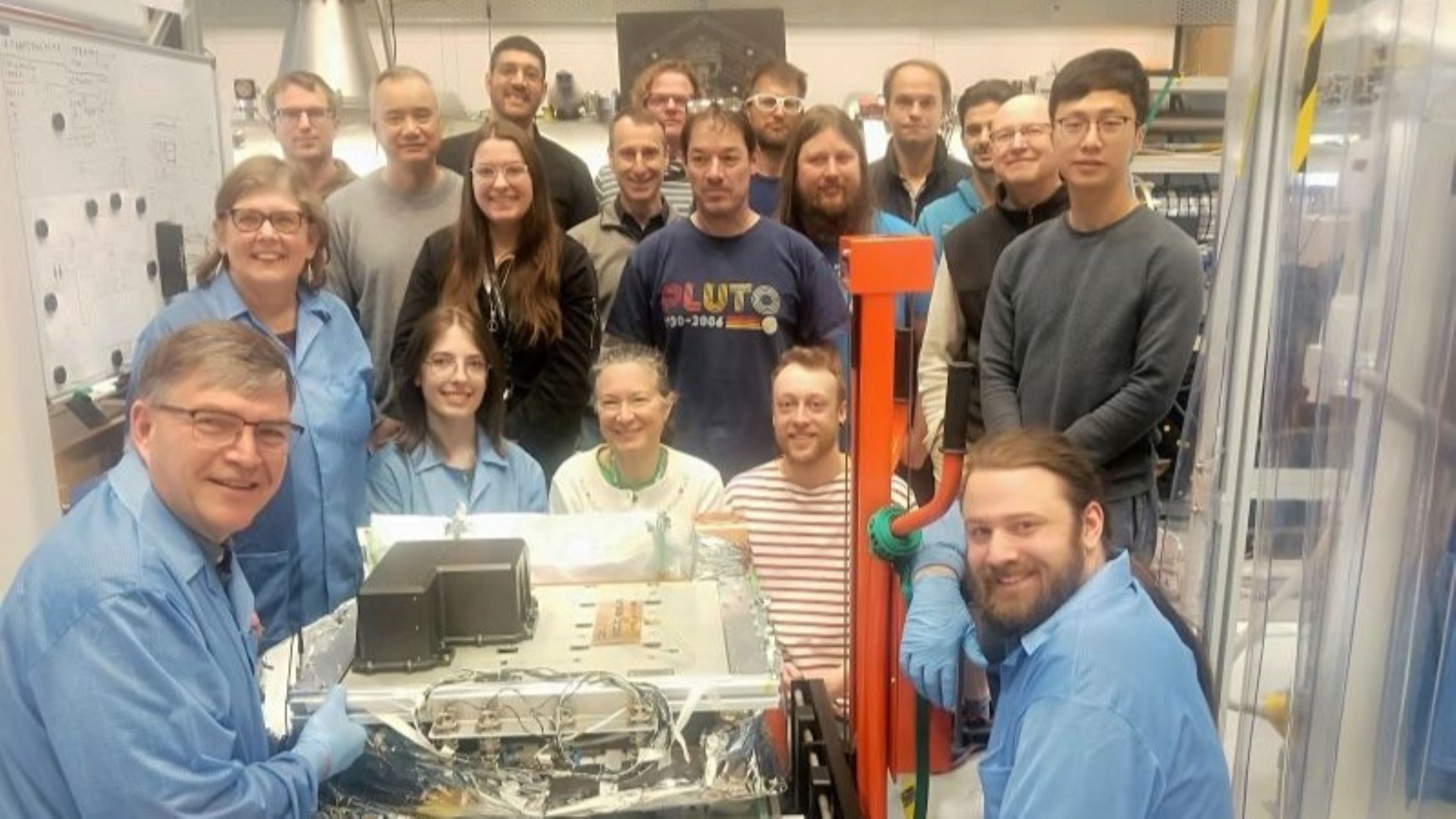
Randy Pollock (front left), Betina Pavri (front centre third from left) and the Hēki team show off their superconducting magnet.
To prove the technology is up to the job, Hēki hitched a ride into orbit on a commercial cargo re-supply flight and spent 10 months circling high above us aboard the International Space Station (ISS). It’s the first time a superconducting magnet of its class has been launched into space and—like proud parents—the team back in Wellington is excitedly awaiting the return of their baby to their lab on Earth.
From laboratory to launchpad
Paihau—Robinson is recognised internationally for its work developing high-temperature superconducting magnets, which have a range of cutting-edge applications in things like MRI scanners. Because these magnets can also dramatically increase the efficiency of ion thrusters, scientists at the Institute could see their powerful superconductors had huge potential for use as an extremely efficient way to propel spacecraft. After receiving a grant from the Ministry of Business, Innovation and Employment (MBIE) to explore that potential, the priority was then to get their invention into orbit to see if it was up to the job. Realising they needed expertise to guide them through the process of testing the technology for space, Paihau—Robinson found the perfect people for the task—a pair of engineers with extensive experience sending instruments into space.
Originally from the United States, Betina Pavri and Randy Pollock both previously worked at NASA’s Jet Propulsion Laboratory (JPL) in California. Randy, who is Paihau—Robinson’s Chief Engineer for Space, worked on a series of missions at JPL doing temperature measurements of the atmosphere, as well as carbon dioxide and dust monitoring. He was also part of a team that developed hardware used on the Mars Perseverance rover.
Betina, a Senior Principal Engineer at Paihau-Robinson, has a background in engineering, physics, and planetary geology and has been involved in a number of NASA’s high profile projects including the Dawn asteroid mission and 15 years with the Mars Curiosity mission, as part of a team designing, testing, and operating its rover on the planet’s surface.
As well as working in the same field, Betina and Randy are partners at home. After signing on the dotted line in 2022, the couple packed up their house in California and moved to Te-Whanganui-a-Tara Wellington. They got straight to work.
The little ‘egg’ with huge potential
Hēki is the te reo Māori word for egg, and the name symbolises the technology’s potential for growth and eventual flight. Getting Hēki into space has been a crucial step towards the development of Paihau—Robinson’s Kōkako thruster—so named for its blue glow, similar to the colour of the distinctive wattles of the kōkako bird.
Randy says that neither he nor Betina lay claim to being superconductor experts, but they could see how they might be able to help Hēki get off the ground—literally.
I like to use the analogy of a coach on a sport team. We’re not electric propulsion experts, but we do know how to approach these sorts of problems—to design for, to test, to structure the way you build complex, experimental hardware.
Randy Pollock
Chief Engineer for Space
“We have been able to lay out the steps the team here needed to take to approach the problem. So we came in and helped the team perform better, just like the goal of a rugby coach is to get the players to perform better and work better as a team,” he says.
Betina says proving the technology worked in the lab was only half the issue.
“Something might work well on Earth, but if the materials don’t function in space, then you don’t have a practical application,” she says.
We needed to show that these novel high temperature superconducting materials could survive the journey into space and operate there without degradation, so actually sending it into space relieves a lot of those concerns.
Betina Pavri
Senior Principal Engineer
The Hēki team worked with Voyager Technologies, a company based in Houston, Texas, to coordinate the NASA review and approval for Hēki, as well as its transport to and operation on the International Space Station.
Hēki was carefully shipped to Houston, and after a few checks it was then transferred to Cape Canaveral, Florida where it was put into a Northrop-Grumman “Cygnus” supply capsule on board a SpaceX Falcon-9 rocket.
Hēki was launched into space in September 2025. Betina says watching the launch live was equal parts exciting and terrifying.
“The launch is a very scary moment because it's entirely out of your control—it’s someone else's job to get the spacecraft safely to the space station. And so it's very dramatic watching it.”
Hēki made it safely to the ISS where it’s spent the last 10 months in orbit. While the excursion has mostly been uneventful, there was one particularly hairy moment.
“There was an unexpected temporary loss of power to Hēki—it is a common concern for superconducting magnets, that if they lose their cooling while they're powered, they can damage themselves,” says Randy.
“We had planned on testing it when we got it home, but then it happened for real one day on the ISS. We were very scared for a couple of days wondering whether it had survived. And so we were very excited when we learned it had made it through. Getting your experiment into space makes everything real, and we got that particular test for free.”
In April Hēki was packed back up into its box and in June it received a lift back down to Earth. Its next move is to Voyager Technologies’ facility to be unpacked and inspected.
“We launched it on a rocket, so it experienced the shaking that you would get in a launch, and then we operated it in the vacuum of space, where it's exposed to large temperature cycles. It's also exposed to space radiation. So we are monitoring its behaviour—hopefully we can show that it can still meet all our performance criteria, even after exposure to these environments,” says Betina.
In April Hēki was packed back up into its box and in June it received a lift back down to Earth. Its next move is to Voyager Technologies’ facility to be unpacked and inspected.
“We launched it on a rocket, so it experienced the shaking that you would get in a launch, and then we operated it in the vacuum of space, where it's exposed to large temperature cycles. It's also exposed to space radiation. So we are monitoring its behaviour—hopefully we can show that it can still meet all our performance criteria, even after exposure to these environments,” says Betina.
Once Hēki’s back in Wellington, the Paihau—Robinson team will conduct detailed performance testing in the lab, including pulling it apart to do detailed testing of individual components.
This will help the team to learn exactly how Hēki’s subsystems perform after their time in orbit and whether each can therefore confidently be used as part of the Kōkako thruster system.
Building a space industry ecosystem
Betina says while the ultimate goal is to develop the Kōkako thruster, which will make propulsion of spacecraft much more efficient, the impact will be felt much more widely.
“The Hēki mission is an important component of being able to commercialise the thruster as a technology. We need to show that it works and that it's practical. To develop this as a commercial technology, several members of our team are creating a new company that will hopefully grow and bring in revenue,” Betina explains.
“We also have people building the infrastructure to support it. We have people building electronics and working in machine shops and all of these people are now benefitting from this investment that is happening.”
We’re excited to be part of building an ecosystem that will support aerospace in Aotearoa New Zealand.
Betina Pavri
Senior Principal Engineer
Betina says it’s fantastic that she and Randy are able to share their experience to help build the space community in Aotearoa.
“The technology is important, but building the people and the team is another crucial aspect of this and an important part of developing these technologies successfully in the future,” she says.
“We’re also building a pipeline of students who now are excited about this work, and they see an opportunity to pursue this kind of work staying here in New Zealand.”
For updates on Hēki’s progress, see the Paihau—Robinson Research Institute’s blog.